The Battle for Truth in the Age of AI Videos: How Do We Survive?
Autolinium Team
Architectural Team
Introduction
A few days ago, a question kept circling in my mind — can AI really be used for both good and bad? The question sounds simple, but as I searched for answers, I came face to face with issues that all of us need to understand. In this article, I've organized those thoughts — the two sides of AI technology, a dangerous consequence of deepfakes known as the "liar's dividend," ways to detect AI videos, and finally, some practical advice.
AI: A Tool, Neither Good Nor Evil
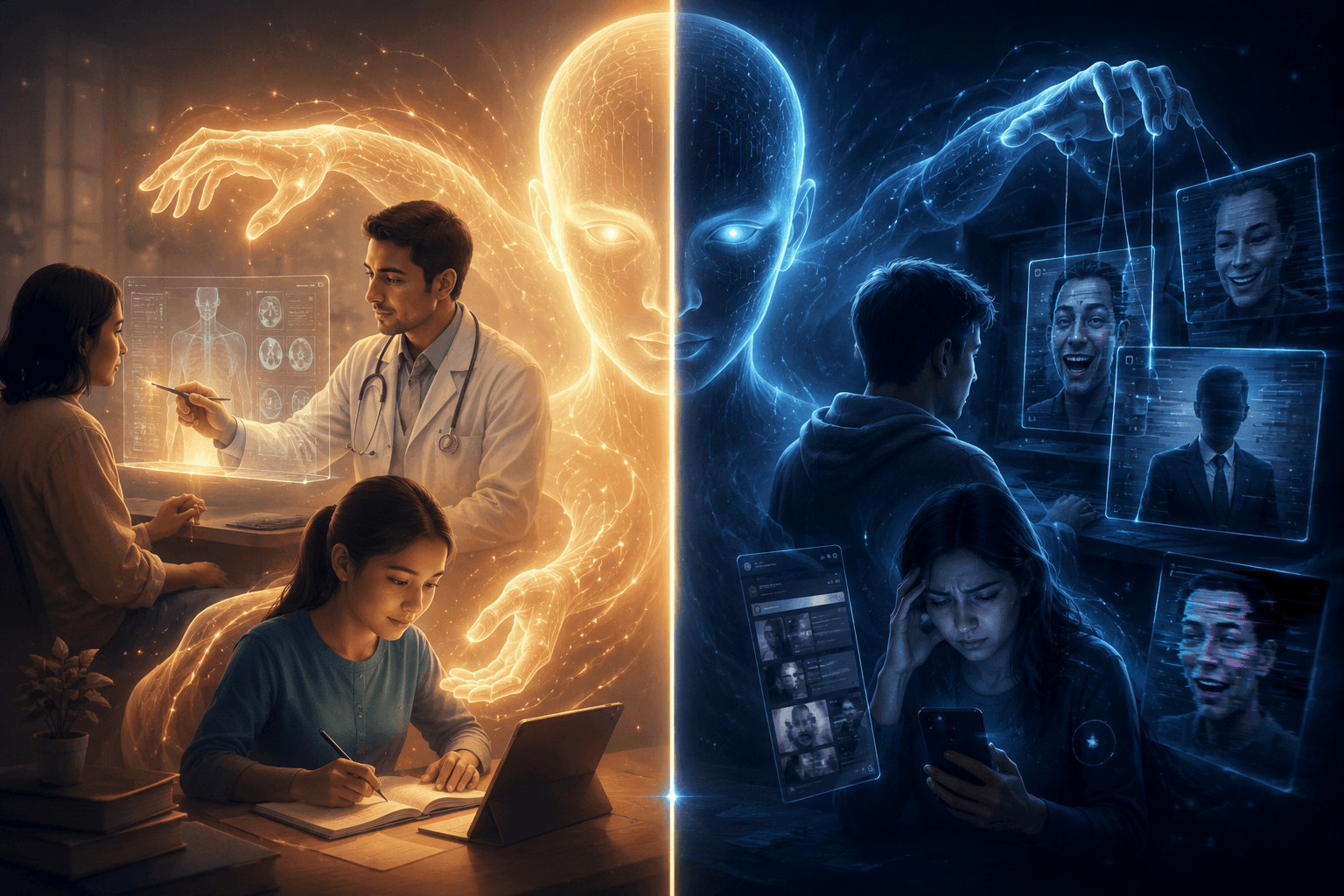
The first truth we need to accept is this — AI itself is neither good nor bad. It is a powerful tool. Just as a knife can be used for cooking or for causing harm, AI works exactly the same way.
On the positive side, the list is long. In healthcare, AI is now helping doctors diagnose diseases and accelerating the discovery of new medicines. In education, personalized support for every student is becoming possible. Language barriers are breaking down — a question written in Bangla can instantly connect with the world's knowledge in any language. From increasing crop yields in agriculture to predicting natural disasters — AI is making human life easier everywhere.
But the coin has another side. Spreading misinformation, creating deepfake videos, fraud, and the misuse of surveillance — these risks are not imaginary; they are real. And among these dark sides, one issue has troubled me the most.
"That's Just an AI Video!" — The New Weapon for Dodging Accountability
We usually fear deepfakes for one reason — someone might create a fake video of us and spread it. That is certainly frightening. But there is an even deeper problem that gets far less attention.
The problem is this — people can now commit real wrongdoing and simply claim, "That's a fake video made with AI!"
Researchers have given this phenomenon a name — the "Liar's Dividend." It means the very existence of deepfake technology has created a bonus advantage for liars. They no longer even need to create fake videos — they can simply dismiss real evidence as "fake."
Think about how dangerous this is. Until now, videos, audio recordings, and photographs were fairly reliable forms of evidence in our society. If someone committed a wrong and was caught on camera, that was considered conclusive proof. But that very foundation is now shaking.
What are the consequences?
First, society runs on trust. When people can no longer believe any evidence, everyone picks their own convenient "truth." Watching the same video, one group will call it real, another will call it fake — and both will remain firm in their beliefs.
Second, the powerful benefit the most from this. Any evidence against them can be dismissed as "AI-generated." Ordinary people have limited ability to verify, so the benefit of the doubt goes to those in power.
Third, it obstructs the path of justice. From courtrooms to public opinion — the credibility of evidence is being questioned everywhere.
The hopeful news is that countermeasures are emerging. Forensic analysis can verify whether a video is real or fake. New cameras are adopting content authentication technology (such as C2PA), which proves where and when a video was captured. Courts are also tightening their standards for verifying digital evidence.
How to Detect AI Videos: Eyes, Tools, and Reason

So how can ordinary people like us tell which video is real and which is AI-generated? The methods can be divided into four categories.
1. Observe With Your Own Eyes
AI videos still carry certain weaknesses:
- Hands and fingers: The number or shape of fingers may look unnatural
- Blinking: Too little blinking, or an odd rhythm
- Teeth, ears, and hairlines: Blurry or inconsistent edges
- Light and shadow: Lighting on the face doesn't match the background
- Lip movement: Lips out of sync with the words (lip-sync issues)
- Background: Text, clocks, or patterns in the background appear distorted or meaningless
- Skin: Overly smooth, with a "plastic-like" appearance
- Jewelry or glasses: Suddenly changing shape or "melting"
2. Use Detection Tools
- Hive Moderation — Checks whether an image or video is AI-generated
- Deepware Scanner — Scans videos for deepfakes
- Intel FakeCatcher — Detects real humans by reading subtle blood-flow signals in the skin
- Reality Defender, Sensity AI — Professional-grade detection services
One caution: no tool is 100% accurate. Treat a tool's result as an indication, not a final verdict.
3. Verify the Source — The Most Effective Method
- Reverse search: Use Google Lens or InVID to search frames from the video and see where and when it was first published
- Find the original source: Check whether the video appears on trustworthy news outlets or official accounts
- Check the metadata: Video files contain information like capture time and device (though this can be erased)
- Content Credentials (C2PA): A new technology that carries a digital certificate of a video's origin
4. Think Critically
- Has the event been confirmed by any independent source?
- Does the video seem designed to provoke an unusually strong emotional reaction?
- What might be the motive of the person sharing it?
Remember — the best results come from combining multiple methods rather than relying on your eyes alone or a single tool. And as the technology improves, spotting fakes visually is becoming harder. That's why source verification — who published it, when, and where — is becoming the most important tool of all.
What We Should Do: Five Habits

From this entire discussion, I've taken away five practical lessons that can help all of us.
1. Pause before you share. If a video or news item triggers intense emotion in you — anger, fear, excitement — that is exactly the moment to be most careful. Fake content is deliberately designed to provoke emotion. Just 30 seconds of pause can prevent many mistakes.
2. "Skepticism" and "distrust" are not the same thing. Assuming everything is fake is also a trap — remember, that's exactly how the liar's dividend gets exploited. Our goal should be to verify and then believe, not to distrust everything wholesale.
3. Build the habit of checking sources. Who is saying it? When was it said? Has anyone else confirmed it? — Turn these three questions into a habit, and most misinformation will expose itself.
4. Teach the people around you. Share what you've learned with family and friends — especially those less familiar with technology. Our parents' and grandparents' generations are the easiest targets of these new deceptions. The greatest defense against misinformation is growing the number of aware people.
5. Don't fear AI — understand it. Those who understand are not easily deceived. Ask questions, learn, and experiment. Curiosity is the greatest protection of this era.
Final Thoughts
AI is one of the most powerful technologies of our time. It can cure diseases and spread education — but it can also blur the line between truth and falsehood. Which path this technology takes depends on how aware and responsible we — its users — choose to be.
"That's an AI video" — these words must never become a shield for dodging accountability, and at the same time, actual fake videos must never be allowed to fool us. Ensuring both is our responsibility. Verify, question, and then believe.
In this fight for truth, every aware person is a soldier. Be one of them.
This article is based on a conversation about AI and deepfakes. Share it to make others aware too.
Related Services
Business Process Automation Services
Streamline repetitive operations and internal workflows.
ExploreMarketing Automation Services
Automate lead generation, outreach, and conversion workflows.
ExploreCustom Software Development Services
Build software tailored to your exact operations and growth model.
ExploreAbout Autolinium Team
Our architectural team focuses on building high-performance, scalable AI systems that transform modern business operations.