Is Claude Replacing OpenAI? 2026 Analysis (Rumor vs. Reality)
Autolinium Team
Architectural Team
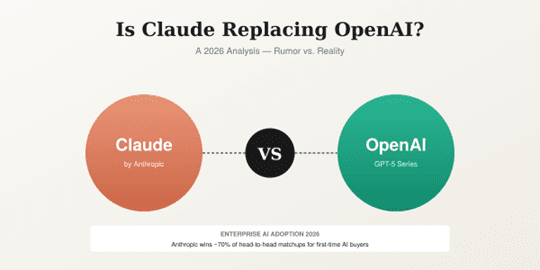
Is Claude Replacing OpenAI? 2026 Analysis: Rumor vs. Reality
Anthropic vs. OpenAI — what the data actually says about the AI throne in 2026.
By Autolinium·AI Automation & Workflow Strategy·8 min read

Image 1: The 2026 narrative - Anthropic's Claude vs. OpenAI's ChatGPT in the enterprise.
In the volatile world of artificial intelligence, the throne is never secure. For years, OpenAI's ChatGPT was the undisputed king of the hill. But as we move through 2026, a new narrative is dominating tech forums, developer Slacks, and Fortune 500 boardrooms: is Claude actually replacing OpenAI?
Depending on who you ask, it's either an inevitable takeover or a persistent rumor. In this analysis, we break down the latest enterprise data, developer sentiment, and platform shifts to answer one question: has the so-called "OpenAI killer" finally arrived or is something more interesting going on?
The Stats: A Seismic Shift in Market Share
OpenAI is still the volume leader by a wide margin, with hundreds of millions of weekly active users and the deepest consumer ecosystem in the AI space. The "replacement" narrative doesn't come from consumers — it comes from the enterprise procurement data.
According to the Ramp AI Index (April 2026), Anthropic now wins approximately 70% of head-to-head matchups among U.S. businesses purchasing AI services for the first time. Anthropic's share of paying business customers jumped from one in 25 a year ago to nearly one in three in April 2026.

Image 2: Anthropic has closed an 11-point gap with OpenAI to just 4.6 points in eight months. Source: Ramp AI Index.
Why the Shift?
- Professional identity. OpenAI has pivoted toward a "consumer super-app" — integrating shopping, travel, and ads into ChatGPT. Anthropic has doubled down on being the "workhorse of the enterprise," with deep integrations into developer tools and financial terminals.
- The coding revolution. Claude Code has become a phenomenon. After launching publicly in May 2025, it crossed $1B in annualized revenue by November and hit $2.5B by February 2026 — the fastest enterprise software ramp in history. Engineering teams are switching to Claude in droves.
- Cultural signaling. Following OpenAI's Department of Defense agreement and the public pushback that followed, choosing Claude has become a kind of professional badge — a signal that you care about safety, transparency, and craft over scale alone.
Claude vs. OpenAI: The 2026 Breakdown
To understand whether Claude is "replacing" OpenAI, you have to look at where each platform actually wins. The debate isn't really about who's smarter — it's about utility. Here's how the two stack up in mid-2026.

Table 1: Feature-by-feature comparison of OpenAI and Anthropic's flagship models, mid-2026.
Fact or Rumor: Is OpenAI Losing the Race?
The truth is more nuanced than a simple replacement story. What we're actually witnessing is platform divergence — two AI giants quietly choosing different battlefields. Let's sort the signal from the noise.
1. The "Human-Like" Writing Edge
FACT
Claude has a measurable edge in copy that doesn't read like AI.
SEO experts and content marketers are switching to Claude for first drafts. The reason is simple: Claude's default output lacks the rhythmic "AI fluff" — the predictable transitions, the over-balanced phrasing, the hollow superlatives — that have become tells for GPT-generated copy. For high-converting landing pages, ad creative, and editorial content, Claude has quietly become the primary draft tool of choice.
2. The Ecosystem Moat
FACT
OpenAI is not being replaced in the average household.
OpenAI's integrations with Microsoft 365, Apple Intelligence, and a sprawling consumer ecosystem give it a distribution moat Anthropic cannot currently match. Most people still encounter AI for the first time through ChatGPT — and that consumer momentum continues to drive a meaningful share of business adoption, especially in non-technical roles.
3. The "Safety" Factor
RUMOR
OpenAI has been "nerfed" — that's why people are switching.
Both companies maintain strict safety protocols, and the "nerfing" narrative is largely overblown. What's real is brand positioning. Anthropic's "Constitutional AI" approach has earned it a safety-first reputation that resonates strongly in regulated industries — law, finance, healthcare — where buyers prioritize predictability and auditability over raw capability.
4. The Developer API Flip
FACT
Anthropic now dominates enterprise API spend.
This one is the most underreported shift of 2026. In July 2025, OpenAI held roughly 95% of enterprise API spend. Eight months later, Anthropic holds about 80%. Claude Sonnet 4.6 and Opus 4.7 have effectively eaten the developer stack. If you're building an AI product right now, the default API call is increasingly to Anthropic.
How Autolinium Sees This Play Out
We build automation systems on top of these models every day — voice agents, custom CRMs, lead generation pipelines, internal copilots — and the picture from the trenches is clear: the question isn't which model to bet on, but how to architect systems that route the right job to the right model.
Here's the framework we use with clients in 2026:
- Use OpenAI when the job is breadth. Real-time data, multimodal voice and image work, broad consumer integrations, fast lookup tasks. GPT-5.5's 1M-token context and computer-use capabilities make it our default for agentic workflows that touch many systems.
- Use Claude when the job is depth. Long-form analysis, code review, complex prompt chains, regulated content, anything where one wrong word costs the client trust. Claude Opus 4.7 is our default for high-stakes single-shot reasoning.
- Don't pick one — orchestrate both. Per Ramp data, 79% of businesses paying for Anthropic also pay for OpenAI. The teams winning with AI in 2026 aren't loyalists; they're routers.
The Verdict: Coexistence, Not Replacement

Image 3: Platform divergence — the 2026 pro stack uses both, for different jobs.
So, is Claude replacing OpenAI? No — it's specializing.
In 2026, the "pro" workflow doesn't pick a side. High-growth teams use OpenAI for the math — technical automation, real-time data fetching, rapid brainstorming — and Claude for the psychology — brand positioning, complex debugging, long-form analysis.
The rumor: OpenAI is dying. The reality: OpenAI is becoming the utility, while Claude is becoming the expert. Both are essential — and the businesses that figure out how to orchestrate both are the ones pulling ahead.
Frequently Asked Questions
Is Claude really better than ChatGPT in 2026?
It depends on the task. Claude leads on long-form writing, complex coding, and reasoning across large documents (200K+ token context). ChatGPT (GPT-5.5) leads on real-time search, multimodal voice and video, and consumer app integrations. Most professional teams now use both.
Why are businesses switching from OpenAI to Anthropic?
Three main reasons: Anthropic's safety-first brand resonates with regulated industries; Claude Code has become the developer favorite, with around 80% of enterprise API spend; and OpenAI's pivot toward consumer features (ads, shopping) has made some enterprise buyers nervous about strategic alignment.
Will Anthropic overtake OpenAI in enterprise market share?
Per the Ramp AI Index, the gap shrank from 11 points in February 2026 to 4.6 points in April 2026. At the current pace, Anthropic could overtake OpenAI on enterprise subscription share within a few months — though OpenAI still leads on overall adoption breadth and consumer momentum.
Should I use Claude or OpenAI for my business?
Use both. Route depth-heavy work (analysis, coding, regulated content) to Claude, and breadth-heavy work (search, multimodal, fast lookups) to OpenAI. If you'd like help architecting that routing layer for your specific workflows, that's exactly what we do at Autolinium.
What is the Ramp AI Index?
The Ramp AI Index tracks paid AI subscriptions across 50,000+ U.S. businesses using corporate card and bill-pay data from financial software platform Ramp. It's widely considered one of the most reliable real-time signals on enterprise AI adoption because it measures actual spend, not survey responses.
Build the Right AI Stack for Your Business
The teams winning with AI in 2026 aren't the ones picking the "right" model. They're the ones building workflow architectures that route the right job to the right tool — and fixing broken processes before automating them.
That's what we do at Autolinium. We build AI-powered automation systems — custom CRMs, voice agents, lead generation pipelines, and internal copilots — that combine Claude, OpenAI, and the right orchestration layer (n8n, Make, custom FastAPI services) for your specific operation.
If you're trying to figure out which AI stack is right for your business — or if you already know and just need someone to build it — book a free workflow audit. We'll map your current processes, identify the highest-ROI automation targets, and recommend a model-agnostic architecture you actually own.
Sources & Further Reading
- Ramp AI Index (April 2026): ramp.com/leading-indicators/april-2026-ai-index
- OpenAI GPT-5.5 announcement: openai.com/index/introducing-gpt-5-5
- Anthropic Claude product page: anthropic.com/claude
- The Register coverage of Anthropic's enterprise surge (March 2026): theregister.com/2026/03/19/anthropic_claude_market_share
Related Services
Business Process Automation Services
Streamline repetitive operations and internal workflows.
ExploreMarketing Automation Services
Automate lead generation, outreach, and conversion workflows.
ExploreCustom Software Development Services
Build software tailored to your exact operations and growth model.
ExploreAbout Autolinium Team
Our architectural team focuses on building high-performance, scalable AI systems that transform modern business operations.