How We Built an AI-Powered Claims Automation Platform for a US Recovery Firm
Autolinium Team
Architectural Team
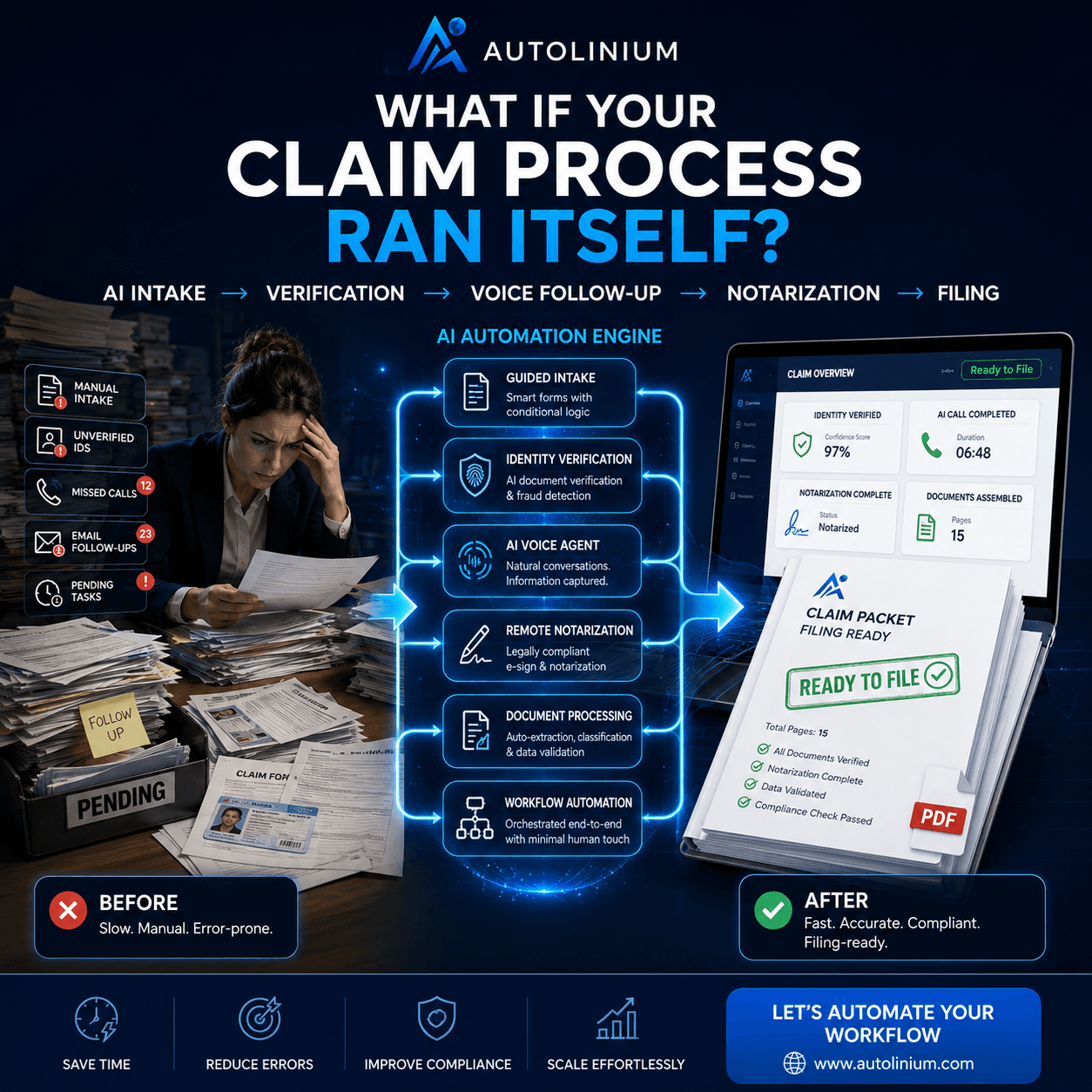
How We Built an AI-Powered Claims Automation Platform for a US Recovery Firm

Most businesses that process claims, applications, or intake forms have the same quiet problem. The work is not complicated. It is just relentless.
Someone collects a form. Someone else checks an ID photo against a name. Someone chases a signature by phone. Someone books a notary. Someone assembles fifteen pages into a submission packet in exactly the right order, because the receiving agency will reject it otherwise. None of these steps require deep expertise. All of them require a human being with time.
That is the bottleneck we were asked to remove.
This is a detailed walkthrough of a system we designed and shipped for a California-based unclaimed property recovery firm. It covers what the manual process looked like, what we built to replace it, the architectural decisions we made, and what we would tell anyone considering a similar build.
The Client and the Problem
Our client recovers unclaimed property on behalf of rightful owners. When a state government holds an unclaimed asset, someone has to identify the owner, prove they are who they say they are, get the paperwork signed and notarized, and file a compliant claim with the state.
Every one of those steps was manual.
A typical claim moved through this sequence:
- Claimant details collected through a basic form or phone call
- Identity documents uploaded and reviewed by eye
- Multiple follow-up calls and emails to confirm details and chase missing information
- Signature collection coordinated over email
- A notary session scheduled and completed
- A final claim packet assembled by hand, page by page, form by form
The firm was not short on claim volume. They were short on hours. Every additional claim meant more staff time, and staff time does not scale linearly with revenue. They also carried real compliance exposure, because manual identity verification and manual packet assembly are exactly the places where human error becomes a rejected filing or a regulatory problem.
They came to us with a straightforward brief: automate the full claim lifecycle without compromising compliance or accuracy.
Design Principle: One Source of Truth, Many Automated Hands
Before writing a single workflow, we made one architectural decision that shaped everything else.
Every claim would live in exactly one place, with one status, one record, one document set. Every automated component would read from and write back to that single record. No component would hold state of its own.
This sounds obvious. It is also the decision most automation projects get wrong. When intake lives in one tool, the CRM in another, call logs in a third, and documents in a fourth, you have not automated a process. You have distributed it, and someone still has to reconcile the pieces.
We used Airtable as the system of record. Every subsequent component was built as a service that operates on that record.

What We Built
1. Guided Intake That Captures Complete Data the First Time
We replaced the old form with a structured intake experience built on Feathery. Rather than presenting one long form, it branches based on claim type and property category, asking only the questions relevant to that path.
The goal was not a prettier form. It was completeness. Every incomplete submission in the old process triggered a follow-up cycle that cost days. Conditional logic, inline validation, and required document uploads at the point of relevance dramatically reduced the number of claims that arrived missing something critical.
On submission, the intake writes a fully populated claim record into Airtable and triggers the first orchestration workflow.

2. Automated Identity Verification with Computer Vision
Identity verification was the single most time-consuming manual step, and the one with the least tolerance for error.
We built an automated verification pipeline using AWS Rekognition. The claimant uploads a government-issued ID and a selfie during intake. The system performs a facial comparison between the two images and returns a confidence score, which is written directly to the claim record.
High-confidence matches proceed automatically. Scores below the threshold are flagged for human review rather than being rejected outright, because a bad lighting condition should not cost a legitimate claimant their property.
That threshold is the important design choice. Full automation of identity decisions is neither compliant nor wise. Automating the ninety percent of clear cases so that humans can focus on the ambiguous ten percent is both.

3. An AI Voice Agent That Handles Follow-Up
Chasing claimants is the least valuable use of a skilled operator's day, and it is unavoidable. Details need confirming. Missing documents need requesting. Status updates need delivering.
We built a voice agent on Vapi, connected to Twilio for telephony, that handles this outbound communication. It calls claimants, confirms details against the record, requests outstanding items, and writes the call outcome and transcript back to Airtable.
Two things made this work in production rather than in demo.
First, the agent operates against the live claim record, so it always knows exactly what is missing for that specific claim and never asks for something already provided. A voice agent working from a generic script is a novelty. One working from live state is infrastructure.
Second, it runs continuously across US time zones. This mattered more than expected on this engagement, because the operating team and the claimants were on opposite sides of the world. The agent covers the hours nobody is at a desk.

4. Remote Notarization Without the Scheduling Overhead
Notarization is a hard compliance requirement, not an optional step. We integrated OneNotary so that once a claim reaches the appropriate status, the notarization session is initiated automatically and the executed documents flow straight back into the claim record.
The scheduling coordination that previously consumed staff time now happens as a state transition.
5. A Document Assembly Engine That Produces Filing-Ready Packets
This was the most technically demanding component and, for the client, the most valuable.
State filings require a specific packet: the correct forms, in the correct order, with the correct exhibits attached, populated with the correct data, and signed in the correct places. Assembling this by hand took significant time per claim and introduced exactly the kind of ordering and completeness errors that cause rejections.
We built a PDF assembly engine that generates the complete packet programmatically. It pulls verified data from the claim record, populates every required form, attaches supporting exhibits and verification artifacts in the mandated sequence, and outputs a single submission-ready document.
What previously took a person a meaningful chunk of an afternoon now happens in seconds, and the output is deterministic. The same input always produces the same correctly ordered packet.

6. Roughly Fifteen Orchestration Workflows Holding It Together
None of the above components talk to each other directly. They are connected through approximately fifteen n8n workflows that handle triggering, state transitions, error handling, retries, and notifications.
We chose n8n specifically because this system needed custom logic, self-hosting flexibility, and the ability to handle complex conditional branching and error recovery without the per-operation pricing pressure that makes high-volume automation expensive on some platforms.
The orchestration layer is where automation projects succeed or quietly fail. Individual integrations are the easy part. What separates a working system from a fragile one is what happens when a verification call times out, an upload fails midway, or a claimant abandons the flow at step four. Those paths need designing with the same care as the happy path.
The Outcome
The claim lifecycle now runs from first submission to signed, notarized, filing-ready packet with minimal human touch.
- Identity verification happens in seconds rather than as a queued manual review
- Follow-up communication runs around the clock without staff involvement
- Document assembly is instant and deterministic instead of slow and error-prone
- Human attention is concentrated on exception handling and judgment calls, which is where it belongs
- Claim volume is no longer directly constrained by headcount
The firm can now grow throughput without proportionally growing the team, which was the actual business objective behind the technical brief.
What We Would Tell Anyone Considering a Similar Build
Automate the process, not the tasks. Bolting an AI tool onto one step of a broken workflow produces a faster broken workflow. The gains here came from the sequence being continuous, with each stage handing off cleanly to the next.
Decide where humans stay in the loop, deliberately. Identity decisions, compliance judgments, and edge cases need human review. Design those checkpoints intentionally at the start. Retrofitting them later is painful and usually incomplete.
Build for the failure paths. Most of the engineering effort in a production automation system goes into what happens when something goes wrong. Budget for it.
Pick your orchestration layer carefully. It is the piece you will live with. Per-operation pricing that looks reasonable at pilot volume can become the dominant cost at production volume.
A Note on Where This Was Built
This system was scoped, architected, and delivered from Chattogram, Bangladesh, for a client in California.
It involved AI voice agents, computer vision, remote notarization, compliance-grade document generation, and a fifteen-workflow orchestration layer, integrated into a single production system operating across a twelve-hour time difference.
Bangladesh is still frequently positioned as a destination for routine development work. Projects like this one are a reasonable argument that the assumption is out of date.
Working With Autolinium
Autolinium is an AI automation and software agency based at Chattogram Software Technology Park. We have delivered 55+ projects across 13+ countries and hold Top Rated status with a 100% Job Success Score on Upwork.
If your business runs a process that looks like this one, repetitive, document-heavy, compliance-bound, and constrained by how many hours your team has, we would be glad to look at it with you.
[Request a Quote] | [Book a Demo]

Draft notes (remove before publishing)
- Client naming: The client is anonymized throughout. If you have written permission from Joseph, swap in the real firm name. A named client is significantly stronger social proof and improves the page's credibility signals.
- Metrics: The results section is deliberately qualitative because I do not have verified before-and-after numbers. If you can get even two hard figures from the client (average claim processing time before and after, or claims handled per week per staff member), add them. Concrete numbers materially improve both conversion and the chance of the page being cited elsewhere.
- Workflow count: Stated as "roughly fifteen." Confirm the exact final number and make it precise if you can.
- Screenshots: Every screenshot must be fully redacted or use sample data. Real claimant data in a public blog post would be a serious problem given the compliance context.
- Internal links: Add the four internal links listed in the metadata block once the Level 2 and Level 3 service pages are live.
- Schema: Add Article schema markup with author, publish date, and organization. Worth doing on every blog post given SEO is the priority.
Related Services
Business Process Automation Services
Streamline repetitive operations and internal workflows.
ExploreMarketing Automation Services
Automate lead generation, outreach, and conversion workflows.
ExploreCustom Software Development Services
Build software tailored to your exact operations and growth model.
ExploreAbout Autolinium Team
Our architectural team focuses on building high-performance, scalable AI systems that transform modern business operations.