How to Track LCs in Garments Accessories Businesses
Autolinium Team
Architectural Team
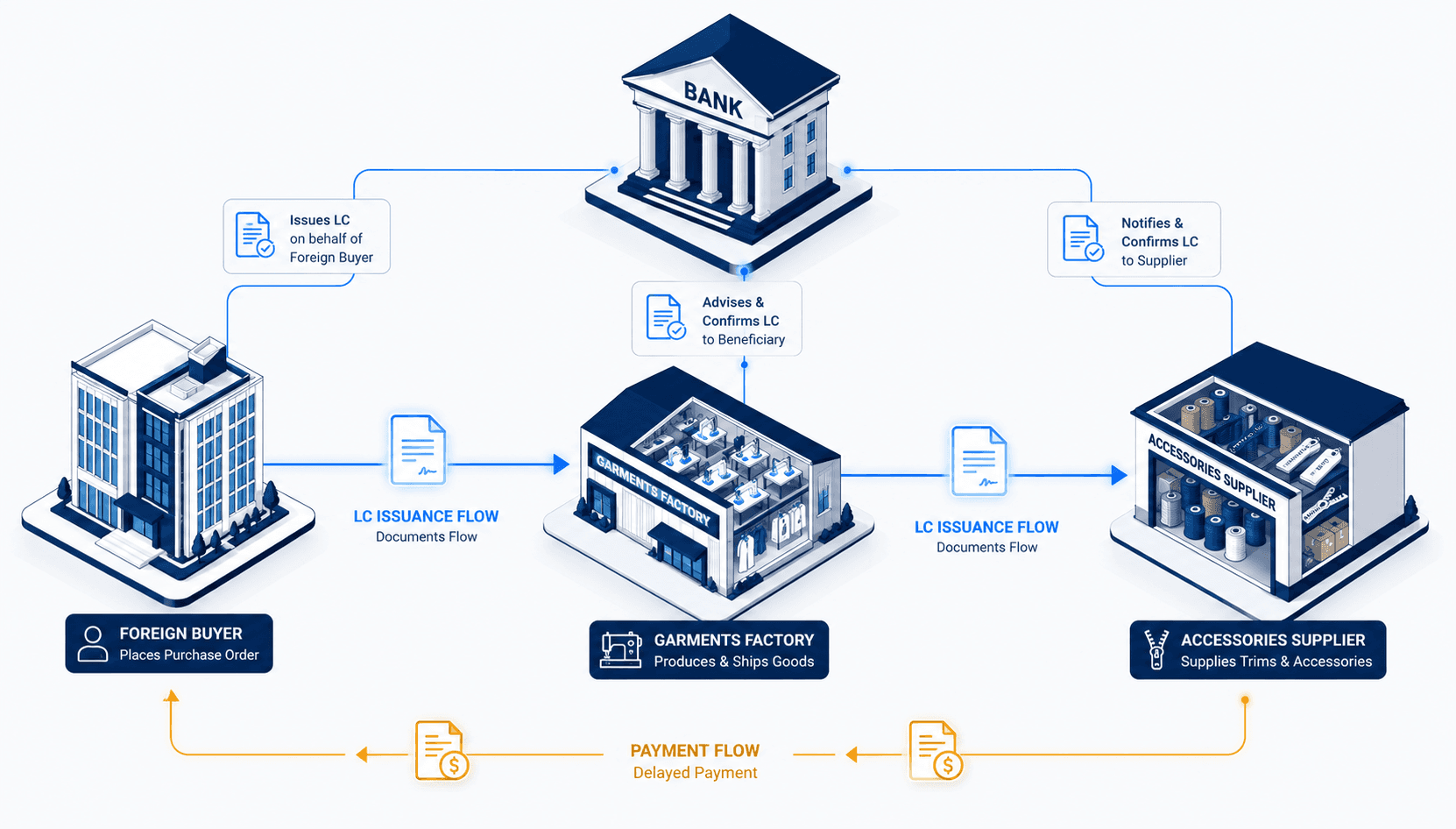
If you supply zippers, labels, buttons, elastic, poly bags, cartons, or interlining to garments factories in Bangladesh, your business does not really run on sales. It runs on Letters of Credit.
You can book a strong order, deliver on time, and still sit with an empty bank account four months later. Not because the customer refused to pay, but because a document reached the bank after the LC expired, or an amendment was never recorded, or a delivery went past the LC balance and there was nothing left to pay against.
LC tracking is not paperwork. It is cash flow control.
The LC Chain Nobody Explains Clearly
Most accessories suppliers learn this the hard way, one mistake at a time. Here is the full picture in one place.
- A foreign buyer opens a Master LC in favour of the garments factory.
- The factory opens a Back to Back LC (BTB) against that Master LC to buy fabric, trims, and accessories.
- You, as the accessories supplier, receive a Local BTB LC, usually denominated in USD even though both parties sit in Bangladesh.
- You deliver against a Delivery Challan, then submit documents to your bank: commercial invoice, delivery challan, bill of exchange, truck receipt, and Mushak 6.3.
- Payment arrives on the maturity date, typically 90, 120, or 150 days usance from acceptance.
Read step five again. Your money is locked for three to five months on every single order. Multiply that across forty active LCs and you understand why accessories businesses with healthy order books still struggle to pay salaries on time.
When working capital is tied up that long, a tracking error is not a small internal problem. It is a payment that lands six weeks late, or never.
What You Actually Need to Track
Most suppliers track two things: the LC number and the amount. That is not enough. Here is the minimum dataset for every LC in your book.
Identity and Parties
- LC number, issuing bank, advising bank
- Applicant (the factory) and the end buyer
- LC type: Master, BTB, or Local BTB, and which parent LC it sits under
Value and Utilization
- Sanctioned LC value
- Value already delivered and invoiced
- Remaining balance, updated in real time
Partial shipments are the norm in this trade, and partial shipments are exactly where manual balance tracking falls apart.
Dates That Block Payment
- LC expiry date
- Last shipment date
- Usance tenor and the calculated maturity date
Change History
- Every amendment, with what changed: value increased, date extended, quantity revised
Bank Status
- Documents submitted, and the submission date
- Acceptance status
- Any discrepancy raised, and whether it was cured
Money
- Amount received against amount outstanding
- Bank charges and commission deducted
- Exchange gain or loss on USD to BDT conversion
Compliance
- UD or UP reference from BGMEA or BKMEA
Five LC Mistakes That Cost Real Money
1. Delivering Beyond the LC Balance
Sales confirms a top-up quantity, production dispatches it, and only at document submission does anyone discover the LC has 4,000 USD of room left against a 9,000 USD delivery. Now you are chasing an amendment for goods already sitting in the factory store.
2. Submitting Documents After Expiry
The LC expired on the 30th. Your documents reached the bank on the 3rd. The bank has no obligation to pay. You are now negotiating, not collecting.
3. Untracked Amendments
The factory extended the shipment date and raised the value by 15,000 USD. Your file still shows the original terms. Your team is planning deliveries against numbers that stopped being true a month ago.
4. Forgotten Maturity Dates
Nobody follows up because nobody knows the date arrived. In a business where a hundred maturity dates land across a single quarter, memory is not a system.
5. No Link Between Challan and LC
This is the root cause of the other four. If a delivery challan is not tied to a specific LC at the moment it is issued, then every balance figure in your business is an estimate.
Why the Excel LC Register Stops Working
Almost every accessories supplier starts with a spreadsheet LC register, and it works fine up to roughly ten or fifteen active LCs.
Then it breaks, and it breaks in a predictable way. The register lives on one person's laptop. Sales does not check it before confirming an order. Delivery does not check it before dispatch. Accounts updates it weekly, from memory, from a pile of challans. By the time the file is accurate, it is describing last month.
The problem is not Excel. The problem is that LC balance is a live number consumed by three departments at three different moments, and a file cannot be live for all of them at once.
What Good LC Tracking Looks Like
The fix is structural. The LC has to live inside the same system where orders, challans, and invoices are created, so the balance moves the instant the business moves.
In practice that means:
- Every sales order is linked to an LC before it can be confirmed
- Available LC capacity is checked at link time, not at document submission time
- Currency consistency between LC and order is validated automatically, so a BDT order can never sit against a USD LC
- Every delivery challan draws down against a specific LC
- Dispatch is blocked when the remaining LC balance cannot cover it
- Cancelling an order releases the committed capacity back automatically
- Realization posts to accounts as a settlement entry, tied to the operational document that created it
None of this is a report. Reports tell you what went wrong last month. Controls stop it from going wrong today.
How SupplyWeave Handles LC Tracking

SupplyWeave is an integrated ERP built for this exact operating model, with Letter of Credit management as a first class module rather than a spreadsheet bolted onto accounting.
LC lifecycle as a controlled state machine. Creation, issuance, document submission, maturity, realization, closure, and cancellation each move through dedicated transitions with validation at every step. No accidental jumps, no editing a live LC into an inconsistent state.
Real time capacity control. LCs link to both sales orders and purchase orders, so the same LC can govern what you sell and what you buy against it. Capacity is checked against committed values as they happen, and cancelling or unlinking an order frees that capacity back automatically.
Currency validation. The system refuses to link an order whose currency does not match the LC. In a market where local LCs run in USD while domestic costs run in BDT, this alone removes a recurring category of reconciliation pain.
Over-delivery prevention. Dispatch is validated against both stock availability and LC utilization, and the check happens at the transition, before the goods leave, not after.
A connected document chain. Proforma Invoice to Sales Order to Delivery Challan to Commercial Invoice, with automatic quantity aggregation from dispatch to invoice. Every quantity has a traceable origin, so LC utilization is derived from actual movements rather than manual entry.
Financial traceability. LC realizations post as settlement documents against the chart of accounts. Cancellation works through reversal rather than deletion, so financial history stays intact and auditable.
A full audit trail. Every mutating operation records the actor, the entity, the action, the outcome, and a before and after snapshot. When a number is questioned six months later, you can answer the question.
Underneath all of it sits inventory tracked by product and size across quantity on hand, reserved, and on order, with Weighted Average Cost recalculated on every goods receipt. LC control and stock control stop being two separate conversations.
Where to Start
You do not need to digitize everything at once. Start here:
- Build one authoritative LC register with all the fields listed above, not just number and value
- Make LC linkage mandatory at sales order confirmation, on paper if you must, before any software
- Never issue a delivery challan without recording which LC it draws against
- Put every expiry, last shipment, and maturity date on one shared calendar
- Reconcile received against outstanding monthly, per LC, not per customer
Do those five things consistently and you will recover working capital you did not know you were losing. Then put it in a system, so the discipline survives staff turnover and peak season.

Talk to Us
SupplyWeave is built by Autolinium for garments accessories businesses that have outgrown spreadsheets.
To see how LC tracking works inside a connected sales, procurement, inventory, and finance workflow, get in touch.
Autolinium Ltd. Chattogram Software Technology Park, Agrabad, Chittagong +880 1533 633084
Related Services
Business Process Automation Services
Streamline repetitive operations and internal workflows.
ExploreMarketing Automation Services
Automate lead generation, outreach, and conversion workflows.
ExploreCustom Software Development Services
Build software tailored to your exact operations and growth model.
ExploreAbout Autolinium Team
Our architectural team focuses on building high-performance, scalable AI systems that transform modern business operations.