China Is Deleting the Arts to Build an AI Economy
Autolinium Team
Architectural Team
Education · Artificial Intelligence · June 2026
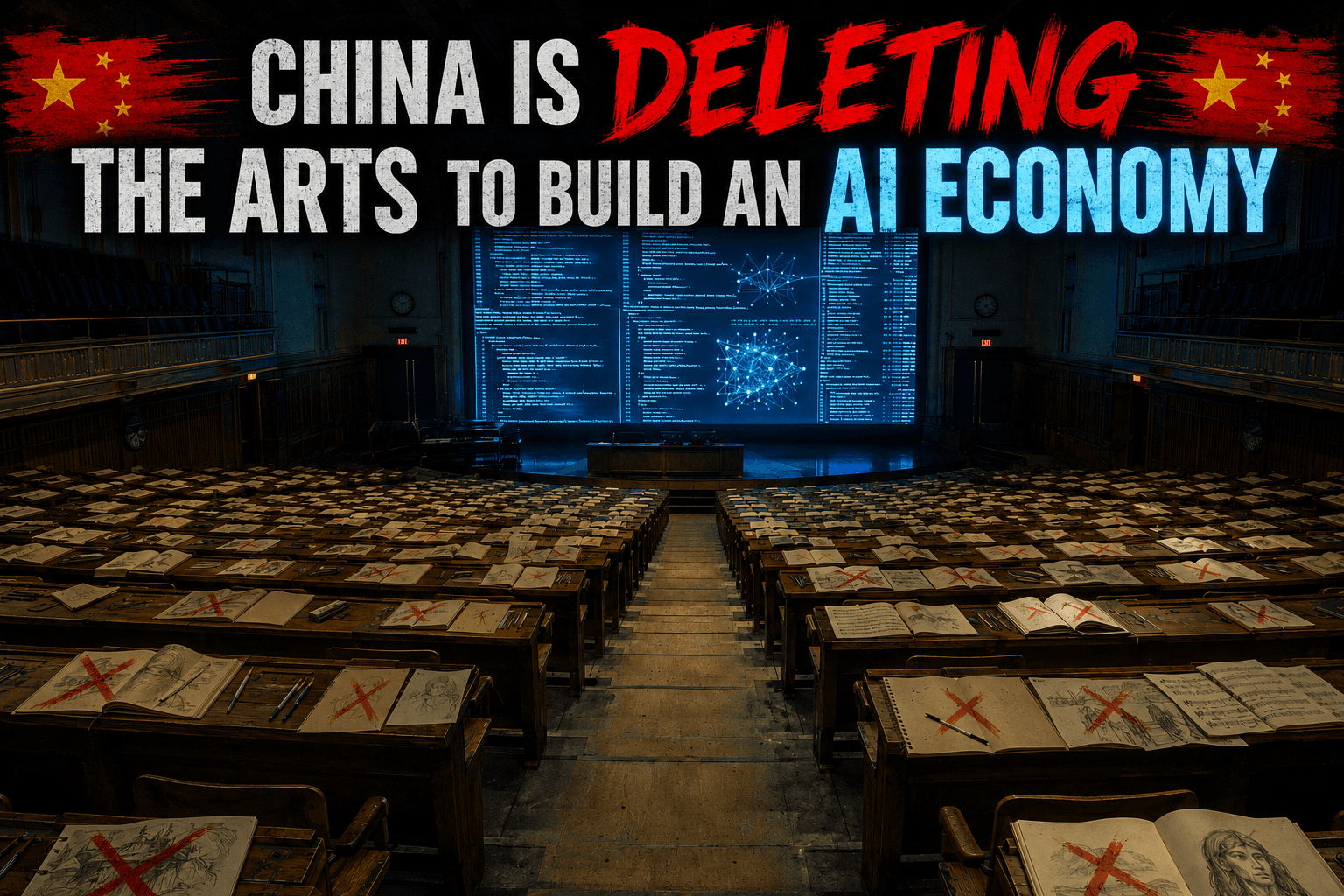
China Is Deleting the Arts to Build an AI Economy
Over 12,000 humanities and arts degrees have been cut from Chinese universities since 2021. This is not just an education story. It is a warning for the rest of the world.
Imagine showing up to university, enrolling in photography or fashion design, and then being told midway through your degree that the program no longer exists. Not because of funding cuts. Not because of low enrollment. But because the government decided your field of study is obsolete.
This is not a hypothetical. This is happening right now across China, at scale, with millions of students affected.
The Numbers Behind the Overhaul
Between 2021 and 2025, China's higher education institutions revoked or suspended 12,200 undergraduate degree programs. In their place, 10,200 new programs were introduced, most of them focused on artificial intelligence, robotics, data science, and technology-integrated disciplines. According to data from China's Ministry of Education cited by Xinhua, this means more than 30 percent of the country's university programs have been restructured.
12,200
degree programs cut or suspended between 2021 and 2025
30%+of all Chinese university programs affected by the restructuring
The cuts have been heavily concentrated in arts, humanities, foreign languages, and management. Fields that administrators increasingly label as "obsolete" and "oversaturated." Meanwhile, new degrees such as "embodied intelligence," "intelligent imaging art," and "intelligent audiovisual engineering" are being positioned as the future.
What Is Actually Being Cut and Why
The five most frequently eliminated majors across China between 2020 and 2024 were: information management and information systems (160 programs), public administration (138 programs), information and computational science (123 programs), marketing (104 programs), and product design (93 programs).
The Communication University of China, one of the country's most respected institutions for media and arts, canceled five undergraduate programs in 2025: photography, comics, visual communication design, new media art, and fashion design. A university official cited "human-machine cooperation" as the rationale, suggesting these creative fields would be replaced or radically transformed by AI tools.
"The rapid development of AI has hit product design hard. Modeling and visualization work that used to require human skill can now be done through AI."
A recent graduate from the University of Shanghai for Science and Technology, speaking anonymously to South China Morning Post.
Tianjin Academy of Fine Arts went further, establishing China's first School of Artificial Intelligence Art in 2024, essentially merging creative education with machine learning research.

The Youth Unemployment Crisis Driving the Decision
To understand why China is making these moves, you need to look at one number: 18.9 percent. That was the youth unemployment rate for 16 to 24 year olds not in school, recorded in August 2025. It was a record high, and it followed years of rising joblessness among graduates.
In 2026, an estimated 12.7 million new graduates are expected to enter China's job market simultaneously. The sectors that once absorbed these graduates, including real estate, finance, and technology, are now shrinking under economic pressure and policy shifts.
The government's response is to reshape what students study before they graduate, betting that tech-aligned degrees will produce more employable citizens. Whether this logic holds is a different question entirely.
The Global Pattern China Is Part Of
India
India has integrated AI literacy directly into its national school curriculum, making foundational AI knowledge part of standard education rather than a specialist elective.
United Arab Emirates
The UAE launched a national AI education initiative targeting students from an early age, with the ambition of making AI fluency as universal as reading and mathematics.
United Kingdom
In 2025, UK Education Secretary Bridget Phillipson announced that the government was exploring a new qualification in data science and AI alongside existing GCSE and A-level credentials. The largest review of the national curriculum in over a decade is expected to be published next year, with implementation beginning in September 2028.
Kazakhstan
Kazakhstan framed AI adoption as a matter of national survival, and has since implemented a new education strategy that centers AI skills across multiple disciplines.
Every major economy is recalibrating its education system. The difference is in how aggressively they are doing it, and at what cost to existing students and fields of knowledge.

The Real Question Nobody Is Asking
Here is the contradiction at the center of China's strategy. The government is cutting arts and humanities degrees because AI is replacing those jobs. But AI is also replacing the very tech jobs these new graduates are being trained for. Automated warehouses already use robotics to replace 90 percent of sorting center workers. A 2025 Chinese court ruling had to formally state that replacing an employee with AI is not a valid reason for dismissal, because it was happening so frequently that labor law could not keep up.
DeepSeek's spokesperson said at the World Internet Conference in November 2025 that the mark of a successful AI revolution is that it replaces the vast majority of human jobs. That statement was not made as a warning. It was framed as a goal.
So what exactly are 12.7 million graduates per year being trained for, if the endpoint of the policy is a labor market transformed beyond recognition?
What This Means Beyond China
China's education overhaul is the most dramatic version of a conversation every country is having. The assumption underneath all of it is that knowing how to work with AI is a sufficient hedge against being replaced by it. That assumption has not been proven.
The arts, humanities, and language disciplines being discarded are not just academic traditions. They are the fields that develop critical thinking, cross-cultural communication, ethical reasoning, and creative judgment. These are precisely the capacities that current AI systems still cannot replicate reliably, and they are the capacities needed to govern, critique, and direct AI systems responsibly.
Cutting them in the name of AI readiness may be the most ironic miscalculation of the century.
The world is watching what China is doing with its universities. The question is whether other countries will learn from it, or simply follow.
Related Services
Business Process Automation Services
Streamline repetitive operations and internal workflows.
ExploreMarketing Automation Services
Automate lead generation, outreach, and conversion workflows.
ExploreCustom Software Development Services
Build software tailored to your exact operations and growth model.
ExploreAbout Autolinium Team
Our architectural team focuses on building high-performance, scalable AI systems that transform modern business operations.