Beyond the Chatbot: 5 Radical Shifts in AI That Are Redefining the Future of Work
Autolinium Team
Architectural Team
Beyond the Chatbot: 5 Radical Shifts in AI That Are Redefining the Future of Work
The initial wave of AI hype has plateaued into a collective exhaustion. We have been bombarded by a relentless cycle of “revolutionary” headlines, yet for most professionals, the technology remains a novelty, a glorified search engine for drafting polite emails or generating quirky images.
This is the “Great AI Overwhelm.”
The problem isn’t a lack of potential; it is a lack of systematization.
We are currently repeating the evolutionary cycle of the digital age: first came the era of static websites, then the dominance of mobile apps, and now, we are entering the era of Revolutionary AI Technologies.
The goal is no longer to simply “know” that AI exists. It is to transition from a passive observer to an orchestrator.
To move from the “chat” phase into a high-impact workflow, you must understand the radical shifts happening under the hood of the global tech economy.

Takeaway 1: The Operator’s Edge — Technical Syntax Is No Longer a Barrier to Entry
In the traditional tech hierarchy, there was a hard wall between the “Builders” and everyone else.
The Builders, the architects at OpenAI, Google, and DeepSeek, possess deep mastery of Machine Learning, Python, and Neural Networks. For decades, they held the keys to the kingdom because they understood the syntax.
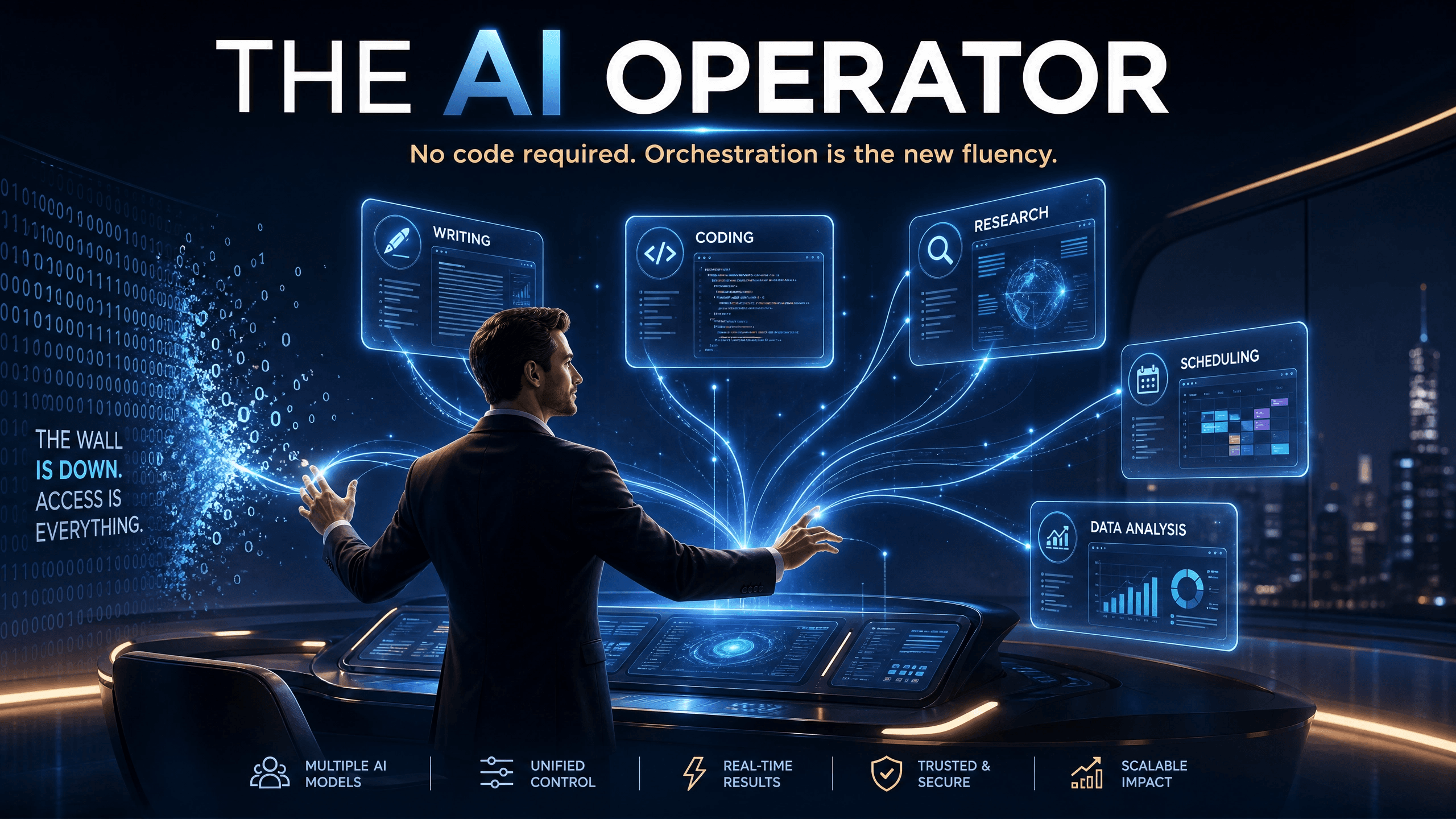
However, the current era has birthed a new power class: the AI Operator.
Who Is an AI Operator?
AI Operators are individuals who treat AI models as a raw resource to be orchestrated rather than a mystery to be solved.
They don’t need to write code or build models; they focus on output, productivity, and problem-solving.
This is the ultimate democratizer of the modern workforce.
The Operator’s value lies in their ability to bridge the gap between business problems and AI solutions.
In this new economy, your proficiency in Python is less important than your ability to systematize these tools to achieve 10X results.
Takeaway 2: The Agentic Shift From Content Generation to Autonomous Execution
We are witnessing the end of “Generative AI” as a standalone category and the rise of “Agentic AI.”
While a Generative AI focuses on the output of content, such as text or images, an AI Agent focuses on the execution of tasks.
From Chatbots to AI Agents
The distinction is best illustrated by the leap from ChatGPT to autonomous platforms like Manus AI.
If you ask a standard chatbot to plan a trip to Tokyo, it provides a text-based itinerary.
If you give that same goal to an AI Agent, it doesn’t just generate text; it searches live tourism sites, parses entry requirements, and creates a functional HTML travel handbook.
This represents the pivot from Automation to Autonomy.
Automation
Rule-based and rigid.
You provide the command; the machine follows a pre-set path, like an Excel macro.
Autonomous Execution
Goal-based and fluid.
You provide the objective, and the AI decides the “How,” navigating live environments and correcting its own course to reach the finish line.
“AI is shifting from a chatbot we talk to, to an autonomous co-worker that works alongside us.”
Takeaway 3: The Reinforcement Revolution How DeepSeek Upended the Status Quo
For years, the industry assumed that high-level reasoning was a “war of capital.”
OpenAI and Google spent enormous amounts on model development. Then came DeepSeek R1, which challenged many assumptions about the economics of advanced AI reasoning.
They did this by challenging the traditional reliance on Supervised Fine-Tuning, or SFT, as the primary scaling step.
The Radical Shift in Learning Styles
Supervised Fine-Tuning, or SFT, can be thought of as “textbook learning.”
The model is fed labeled data and told the correct answer by a human. It learns from what it has been shown.
Reinforcement Learning, or RL, is different.
Think of how a child learns to ride a bike. They don’t read a manual. They try, they fall, they adjust, and eventually they learn how to balance.
Why Reinforcement Learning Matters
By using large-scale reinforcement learning, DeepSeek demonstrated a different approach to developing reasoning capabilities.
The model can explore possible solutions, evaluate outcomes, and improve its reasoning strategies.
This creates more sophisticated reasoning behavior and contributes to what is commonly described as Chain of Thought, where the AI works through a problem via intermediate reasoning steps before presenting an answer.
This shift makes AI a better reasoner and a more efficient coder, challenging the idea that intelligence is simply a function of model size and financial investment.
The broader lesson is clear: intelligence can increasingly be developed through logic, exploration, verification, and feedback.
Takeaway 4: The Hidden Tax on Politeness

In the world of Large Language Models, or LLMs, human social instincts can become a technical inefficiency.
Humans naturally write:
“Please…”
“Thank you…”
“I would be grateful if…”
“Could you kindly…”
AI does not process language in the same way humans do. It processes language as tokens.
What Is a Token?
A token can be a word, part of a word, punctuation, or other pieces of text.
For example:
“Information” can be processed as “Infor” + “mation”.
Spaces and punctuation can also contribute to token usage.
That means every unnecessary word can carry a computational cost.
The Cost of Extra Words at Scale
If a company processes 1 million prompts per day and each user adds several unnecessary words to every prompt, those extra tokens accumulate rapidly.
At massive scale, unnecessary token usage can translate into additional processing costs, energy consumption, and latency.
While being polite is a human virtue, in the prompt box, brevity can be a financial and environmental imperative.
The lesson is simple: say what you need to say, and remove what you don’t.
Takeaway 5: The Death of the Manual Data Entry Role
The synthesis of multi-tool workflows, such as combining the reasoning capabilities of Gemini with the data-processing capabilities of ChatGPT, has fundamentally changed the economics of traditional data-entry work.
Consider the Zomato DHRP, a financial document spanning hundreds of pages.
A modern AI workflow can process such a document, extract critical financial metrics, identify profit-and-loss trends over multiple years, and transform the raw information into structured Excel sheets and visualizations in a fraction of the time traditionally required.
From Data Entry to Insight Analysis
Previously, much of the work involved:
Finding the data.
Reading the data.
Copying the data.
Entering the data into spreadsheets.
Formatting the data.
Creating reports.
AI can increasingly automate large portions of this process.
The human role therefore moves upward.
The New Value Chain
The value is no longer primarily in finding the data or typing it into a cell.
The value is in interpreting the visualizations.
- It is in understanding what the data means.
- It is in identifying patterns.
- It is in asking better questions.
And ultimately, it is in making better decisions.
The “Data Entry” clerk is being replaced by the “Insight Analyst.”
This transition turns days of manual labor into seconds of orchestration, shifting the human’s role from “producer of data” to “consumer of insights.”
Conclusion: The 10X Productivity Frontier
The era of dabbling in AI is over.
Simply knowing that AI exists is no longer enough.
Simply knowing how to use ChatGPT is no longer a meaningful competitive advantage.
To remain market-ready, professionals must move through a systematic methodology: from AI Foundations to Prompt Engineering, into AI for Study and Research, and finally toward Market Readiness.
AI Foundations
Understand what modern AI systems are, what they can do, and where their limitations lie.
Prompt Engineering
Learn how to communicate effectively with AI systems and consistently produce useful outputs.
AI for Study and Research
Use AI to accelerate learning, research, analysis, synthesis, and knowledge discovery.
AI-Powered Workflows
Move beyond individual prompts and connect AI with tools, data, applications, and business processes.
Market Readiness
Transform these capabilities into measurable productivity, better decision-making, and real-world professional value.
This roadmap ensures that you aren’t replaced by an algorithm, but rather empowered by one.
As we move toward an era of autonomous agents and reinforcement-driven reasoning, the technical barriers to entry are disappearing, leaving us with one provocative question:
If an AI Agent can handle your research, your scheduling, your data entry, and your first drafts today, what is the single most valuable human skill you should be doubling down on tomorrow?
Related Services
Business Process Automation Services
Streamline repetitive operations and internal workflows.
ExploreMarketing Automation Services
Automate lead generation, outreach, and conversion workflows.
ExploreCustom Software Development Services
Build software tailored to your exact operations and growth model.
ExploreAbout Autolinium Team
Our architectural team focuses on building high-performance, scalable AI systems that transform modern business operations.