AI vs EI: Which Intelligence Matters More for Your Career in 2026?
Autolinium Team
Architectural Team
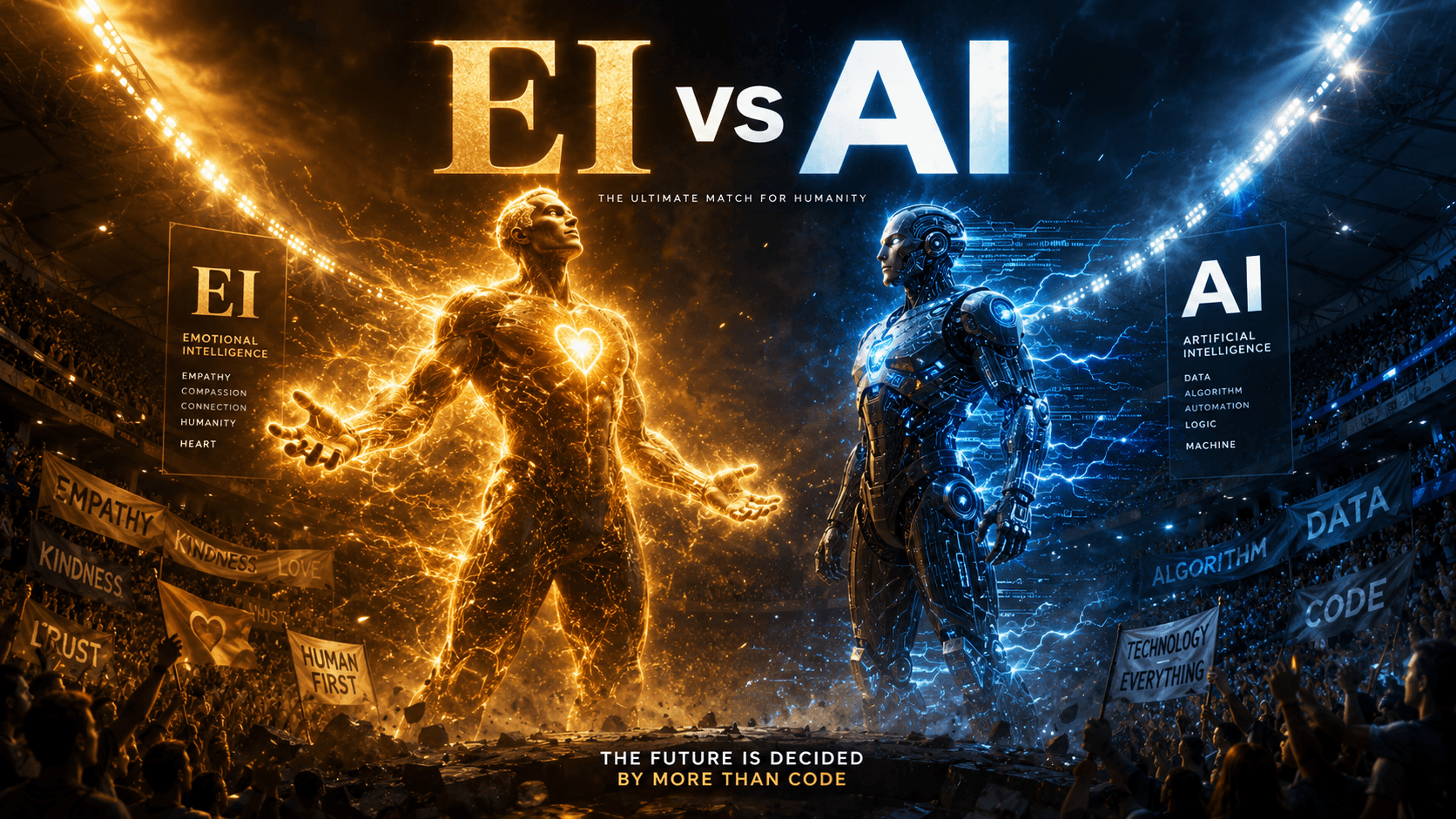
Published by Autolinium | June 2026 | Reading time: ~6 minutes
We live in an era where machines can diagnose cancer, write code, and negotiate contracts. Yet the most effective professionals in the world are not those who simply use the best AI tools. They are those who combine artificial intelligence with something deeply human: emotional intelligence (EI).
So what is the real difference between AI and EI? Which one matters more for your career? And how do you get the balance right? This guide answers all three.
What Is Artificial Intelligence (AI)?
Artificial Intelligence refers to machine systems designed to perform tasks that typically require human cognition — pattern recognition, language processing, data analysis, and decision support.
In 2024, 72% of organizations globally had integrated AI into at least one core business function, up from 55% the prior year (ESCP Business School, 2024). AI is no longer a future trend. It is the present standard.

What Is Emotional Intelligence (EI)?
Emotional Intelligence, popularized by psychologist Daniel Goleman in his landmark 1995 book, is the capacity to recognize, understand, manage, and effectively use emotions — in yourself and in others.
The 5 Core Components of Emotional Intelligence
- Self-Awareness — Recognizing your own emotional states
- Self-Regulation — Managing disruptive emotions and impulses
- Motivation — Harnessing emotions toward meaningful goals
- Empathy — Understanding others' feelings and perspectives
- Social Skills — Building and sustaining productive relationships
"At best, IQ contributes about 20 percent to the factors that determine life success, which leaves 80 percent to other forces." — Daniel Goleman, Emotional Intelligence (1995)
What AI Cannot Do — The Core Difference
AI processes data. It optimizes. It scales. But AI cannot feel, trust, grieve, inspire, or forgive. A 2024 survey of 692 global business leaders found that character-based traits such as integrity and interpersonal skills will become more important as AI and automation advance (Cardon et al., 2024).
Research in Behavioral Sciences (2025) also found that AI collaboration led to a measurable decline in emotional exchange between employees — creating workplace challenges that only high-EI leaders can navigate.
"CEOs are hired for their intellect and business expertise and fired for a lack of emotional intelligence." — Daniel Goleman
Which Professionals Need What? A Role-by-Role Breakdown
1. Leaders and Executives
For senior professionals, EI is non-negotiable. Goleman's research found that 85% of distinguishing leadership competencies fall within the EI domain. AI can surface business intelligence, but leading through uncertainty, managing team morale after failure, and building client trust require human emotional depth.
Best approach: High EI, with AI as a strategic decision-support tool.
2. Software Engineers and Data Scientists
As AI automates code generation and data pipelines, what differentiates a great engineer is no longer just what they build — it is how they collaborate, communicate trade-offs, and align with business goals.
Best approach: Strong AI literacy, with growing investment in EI for cross-functional effectiveness.
3. Healthcare Professionals
Patient communication, bedside manner, ethical decision-making, and end-of-life conversations require deep EI. A 2024 EuroAIM study found that about half of radiologists did not foresee a reduction in their professional relevance despite AI's rise — pointing to the irreplaceable human layer in clinical care.
4. Salespeople and Client-Facing Roles
AI can personalize outreach and automate follow-ups. But the moment of trust, the emotional read of a client's hesitation, the rapport that closes a deal — that remains entirely human (Sharma & Saxena, SAGE Journals, 2024).
Best approach: EI-first, AI-assisted.
5. Entrepreneurs and Founders
Investors fund founders as much as ideas. EI drives the team-building, storytelling, and resilience that sustains a startup through adversity. AI handles the execution layer.
Best approach: EI as the foundation, AI as the force multiplier.
How AI and EI Together Shape Your Career
Consider two professionals with identical IQs and technical skills. The one who can motivate a burned-out team, de-escalate a conflict before it becomes a resignation, or read a room to pivot a pitch in real time — will consistently outperform.
Goleman's research found that emotional competencies were twice as prevalent among high performers compared to technical skills and cognitive ability combined, across all job levels studied.
"In a high-IQ job pool, soft skills like discipline, drive, and empathy mark those who emerge as outstanding." — Daniel Goleman
A 2025 review of 40 peer-reviewed studies found that AI adoption improves efficiency but can simultaneously erode professional identity and cause digital fatigue — when not paired with emotionally intelligent leadership (MDPI, Societies, 2025). The opportunity is not AI versus EI. It is AI multiplied by EI.

Key Takeaways for Professionals
- EI is not soft. It is the highest-leverage skill in a world where AI is commoditizing technical output.
- AI fluency is not optional. It is now a baseline career requirement across every profession.
- The ideal balance varies by role, but the direction is universal: build both, in proportion to your domain.
- Leaders need EI most. The higher you go, the more your success depends on how you manage people — not systems.
- Engineers and clinicians need AI literacy most, layered over a growing EI foundation.
References
- Goleman, D. (1995). Emotional Intelligence: Why It Can Matter More Than IQ. Bantam Books.
- Goleman, D. (1998). What Makes a Leader? Harvard Business Review.
- Cardon, P. et al. (2024). Competencies needed by business professionals in the AI age. Business and Professional Communication Quarterly, 87(2), 155–180.
- Sharma, S. & Saxena, P. (2024). Role of emotional and artificial intelligence in employee performance. SAGE Journals.
- Meng, Q. et al. (2025). Effects of employee-AI collaboration on counterproductive work behaviors. Behavioral Sciences, 15(5), Article 696.
- MDPI Societies. (2025). Artificial Intelligence and the Reconfiguration of Emotional Well-Being (2020–2025).
- ESCP Business School. (2024). AI and Emotional Intelligence: Bridging the Human-AI Gap.
- EuroAIM/EuSoMII. (2024). Impact of AI on radiology. PMC.
Written by Autolinium
Related Services
Business Process Automation Services
Streamline repetitive operations and internal workflows.
ExploreMarketing Automation Services
Automate lead generation, outreach, and conversion workflows.
ExploreCustom Software Development Services
Build software tailored to your exact operations and growth model.
ExploreAbout Autolinium Team
Our architectural team focuses on building high-performance, scalable AI systems that transform modern business operations.